Muhurtha app icon
iPhone & iPad · iOS 18+ · Android coming soon

Muhurtha

A Hindu calendar that actually explains itself. Muhurtha gives you today's Panchang — tithi, nakshatra, yoga, karana and vaar — with Rahu Kaal and Abhijit as plain times you can act on, 163 festivals across ten regional traditions, eclipse visibility from where you stand, Pitru Paksha shraddha days, and a muhurat finder for a wedding, a housewarming or a new car. Every term has a tap-to-read explanation in ordinary English, so you never have to already know what Ekadashi means to use it, and the whole app reads in English, Hindi, Marathi, Gujarati, Bengali, Tamil, Telugu, Kannada, Malayalam or Odia. Everything is computed on your phone from the positions of the Sun and Moon. No account, no ads, no network, and nothing to buy.

Panchang means "five limbs". Most apps show you all five and explain none.

Muhurtha shows the same five, and tells you what each one is for.

TithiThe lunar day. Changes when the Moon gains another 12° on the Sun — so it rarely starts at midnight.
NakshatraWhere the Moon is sitting tonight, out of 27 star-groups. This is the "my nakshatra" people mean.
YogaSun and Moon added together. Twenty-seven of them; a handful are worth avoiding.
KaranaHalf a tithi. Two per day, and one of them — Vishti — is the one elders tell you to sit out.
VaarThe weekday, but measured sunrise to sunrise. Before dawn still counts as yesterday.
Today

One screen that answers "is now a good time?"

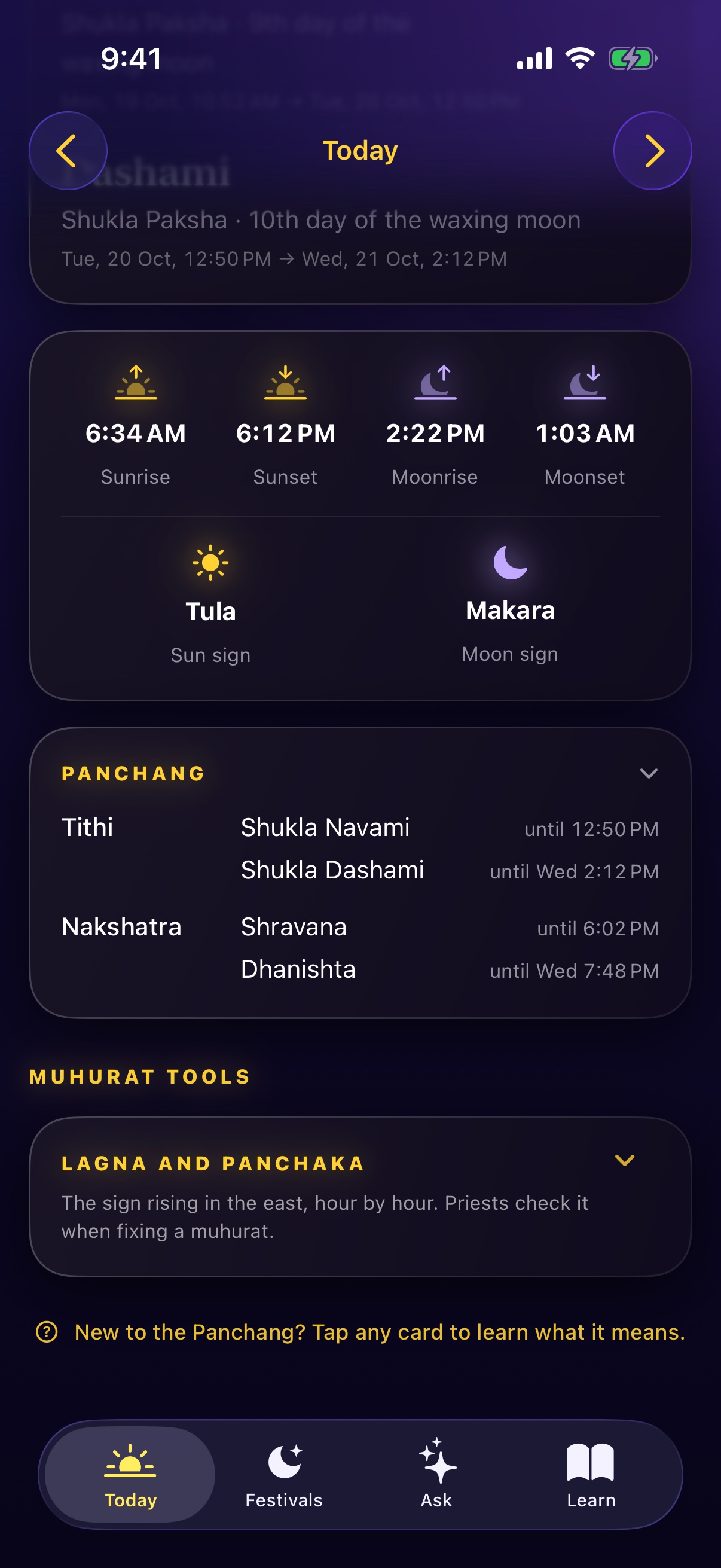
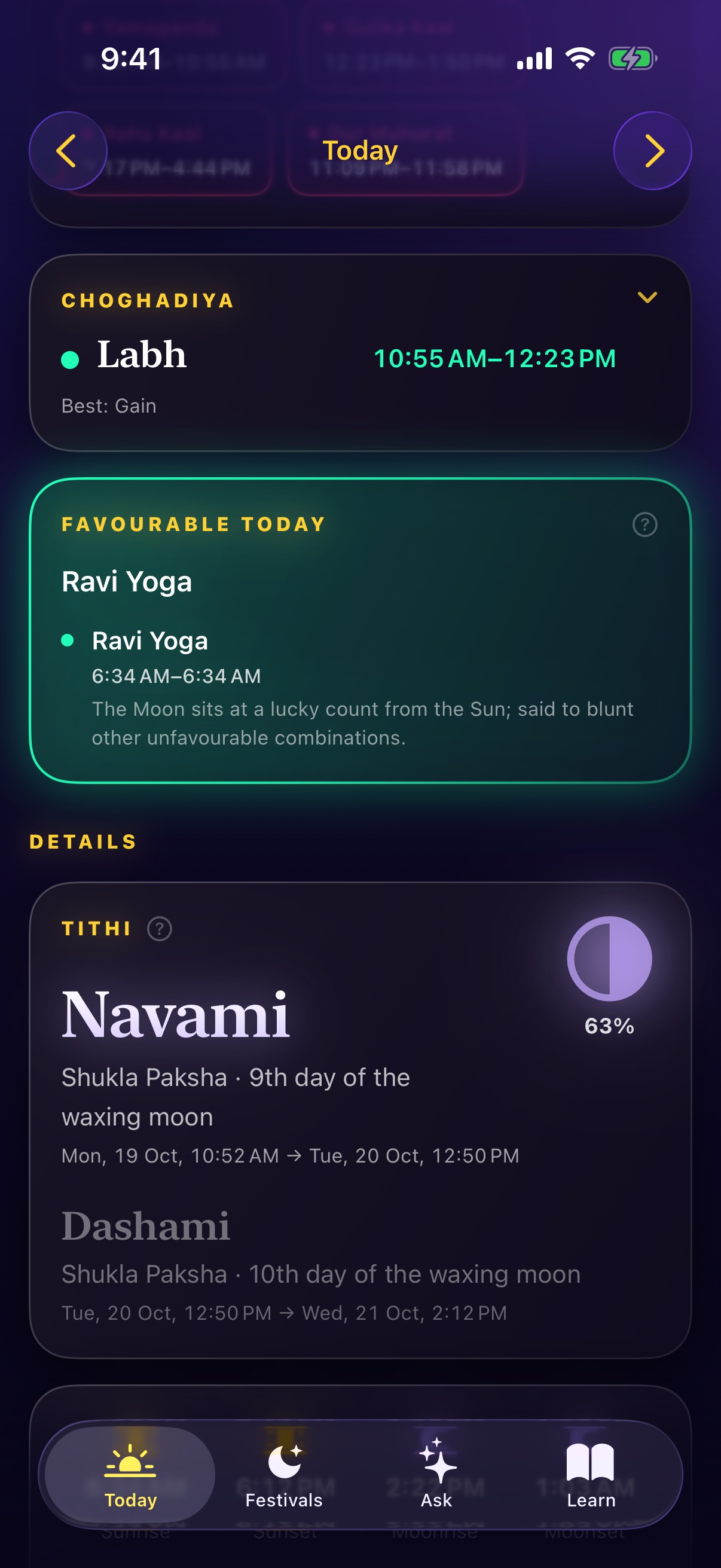
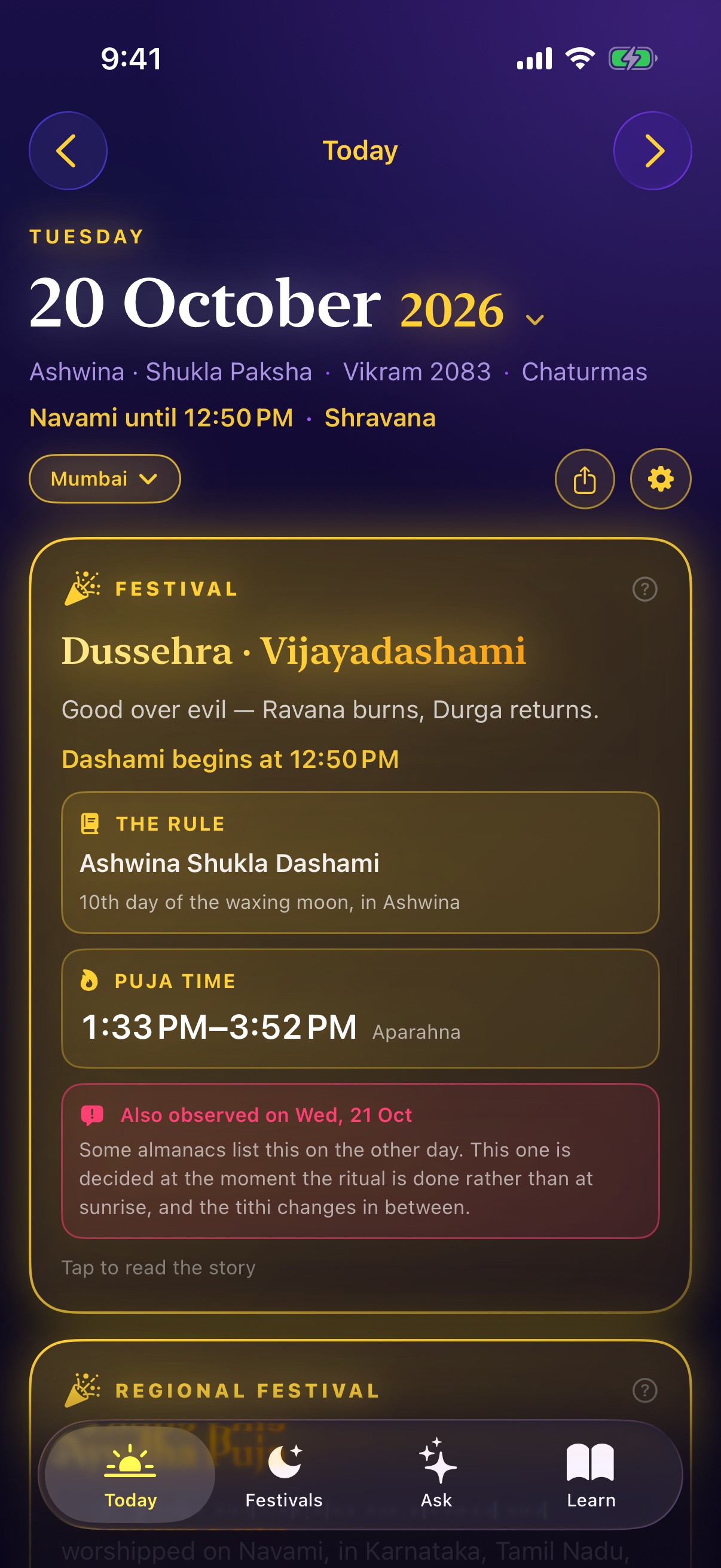
The day opens with what is actually happening: a fast, a festival, someone's tithi birthday. Then Plan your day — one sentence naming the next good window and how long until it opens, and the hours to leave alone.

Tap anything and it explains itself. What Pradosh is for. Why Rahu Kaal is an eighth of the daylight and not a fixed 90 minutes. What the 13th moon day has to do with Shiva. On a festival day each card also says when its tithi begins or ends, so two festivals on one day read apart.

Sunrise, sunset, moonrise Both month systems Choghadiya Vikram & Shaka samvat
Muhurtha's Today screen showing a fast, a tithi birthday and the day's windows
Windows of the day

And when a good hour and a bad one collide, it says so.

Abhijit sits at midday. On a Wednesday, Rahu Kaal sits there too. Most apps print both in green and red and leave you to notice. Muhurtha strikes the good one out, says which window overrode it, and stops offering it as the day's best.

Any auspicious Choghadiya that runs into Rahu Kaal, Yamaganda, Gulika or Dur Muhurat is dropped the same way — so the windows you are shown are the ones that survive.

Labh6:27 AM – 7:58 AM
Abhijit12:06 PM – 12:55 PMRahu Kaal overrides
Rahu Kaal12:30 PM – 2:01 PM
Abhijit struck through with Rahu Kaal overrides beneath it
The year

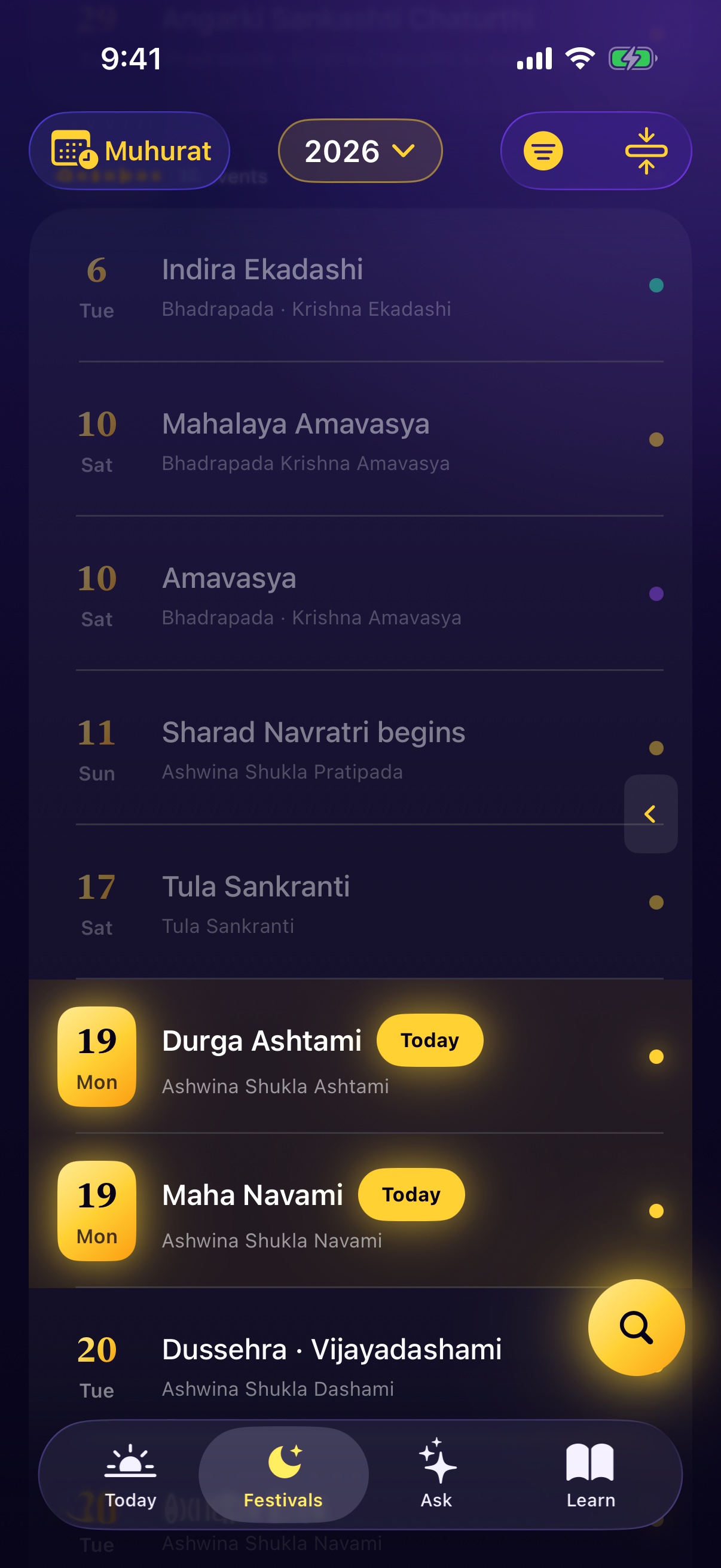
163 festivals, dated from the Moon — not from a list someone typed in.

Every festival in Muhurtha is a rule: a tithi, in a month, judged at the moment tradition judges it. Diwali at twilight, Janmashtami at midnight, Ganesh Chaturthi at midday. Change city and the dates move, because for some years and some places they genuinely do.

Pick the traditions you actually follow and the rest disappear — including Tulu Nadu's own calendar, which almost nothing else carries. The Jain calendar is a switch of its own: Shvetambar Samvatsari and Paryushana dates, and the Chauvihar time on Today.

Pan-HinduNorth IndiaMaharashtraGujarat Bengal & EastTamil NaduKeralaKarnataka Tulu NaduAndhra & Telangana
A year of festivals, ekadashis, purnimas and eclipses
The month

Find the Purnima, the Amavasya and the fast in one glance.

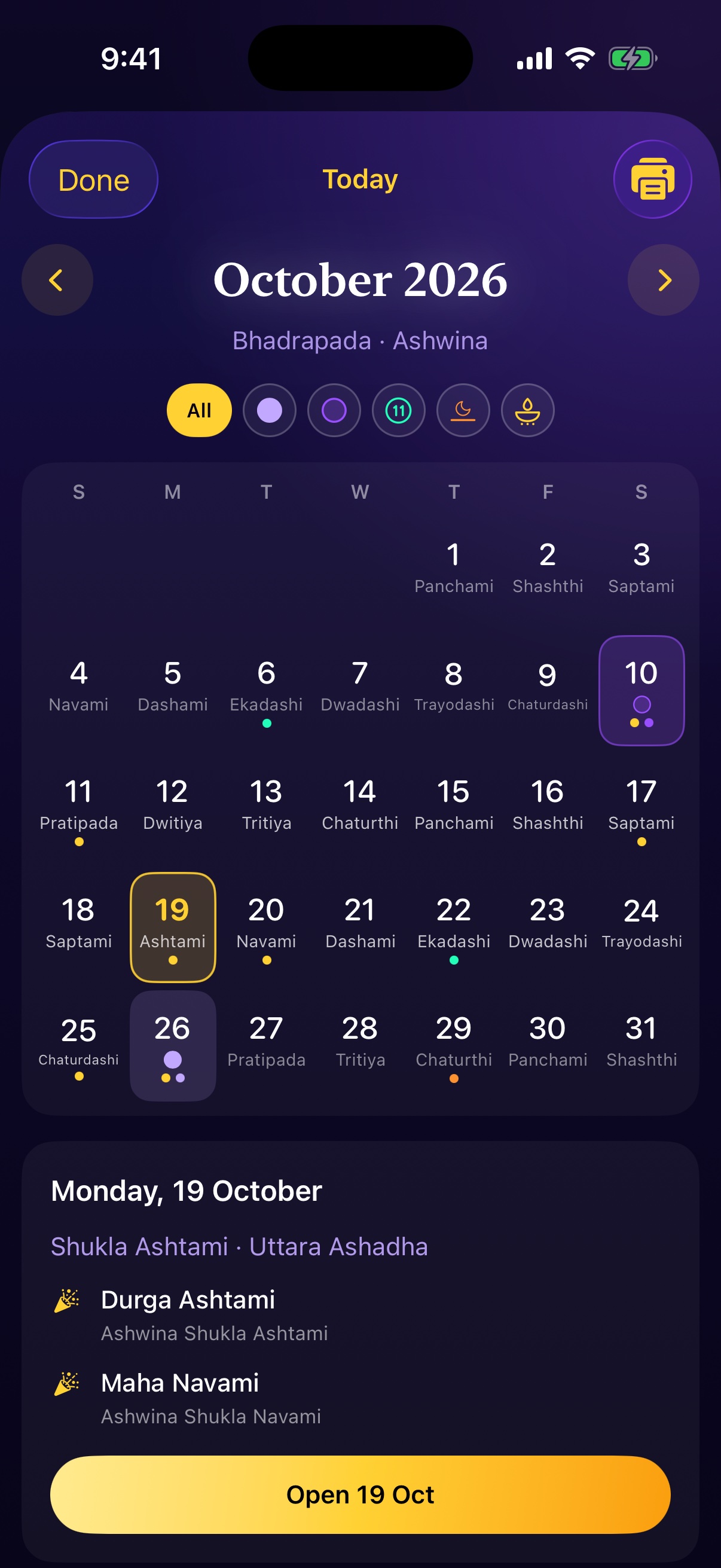
The month grid marks every day's moon, and a row of filters picks out what you are looking for: Purnima, Amavasya, Ekadashi, Sankashti, or the festivals you follow. Each filter lights up only its own days, so a whole month reads in seconds.

The moon phase stays under every date, the selected day is gold, and the grid opens on All each time you come back, so a filter never sticks around by accident.

Purnima Amavasya Ekadashi Sankashti Festivals you follow
The month grid for October 2026 with the filter row, moon dots and the selected day in gold
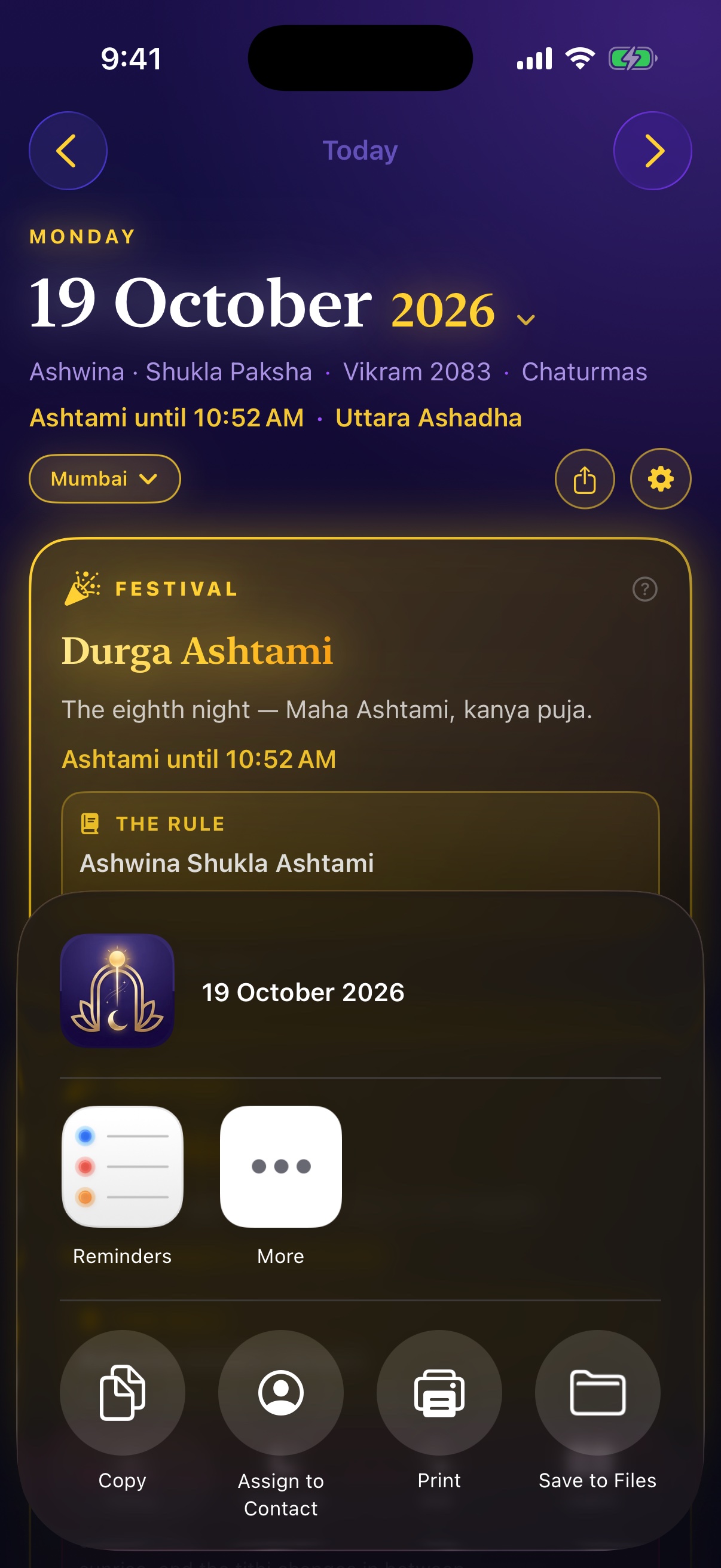
Share

A whole day, in one picture for the family group.

Tap share and the day becomes a tall JPEG: the date and moon, the festival and the rule that puts it there, the Panchang, and every safe and caution window with its time. The app's address sits on the card, so anyone who sees it knows where it came from.

Sharing a festival gives its own card with the story and how it is kept.

A shared Muhurtha day card with the festival, Panchang and safe and caution windows
Muhurat

A year of dates for the things people plan around a Panchang.

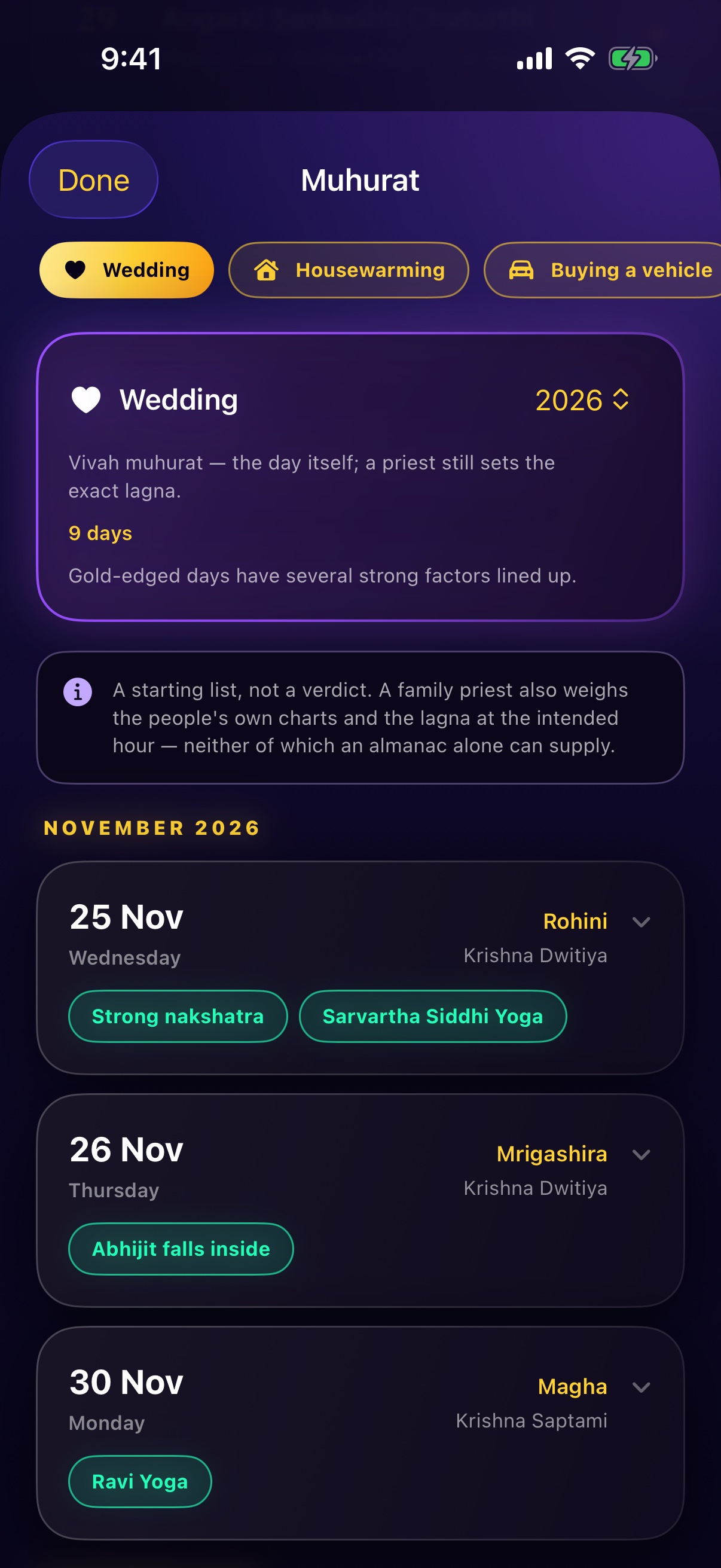
Wedding, griha pravesh, a vehicle, property, a new venture, a naming. Muhurtha walks the year, keeps the days whose tithi, nakshatra and weekday all clear the traditional shortlist, and shows you the hours within each one — with Rahu Kaal, Yamaganda, Gulika and Dur Muhurat already cut out.

Weddings and housewarmings respect Kharmas and Chaturmas. Buying a car does not, because tradition never asked it to.

It is a starting list, not a verdict. A family priest also weighs the couple's own charts and the lagna at the intended hour — neither of which an almanac alone can supply, and the app says so on the screen.

Wedding muhurat dates for a year with their usable hours
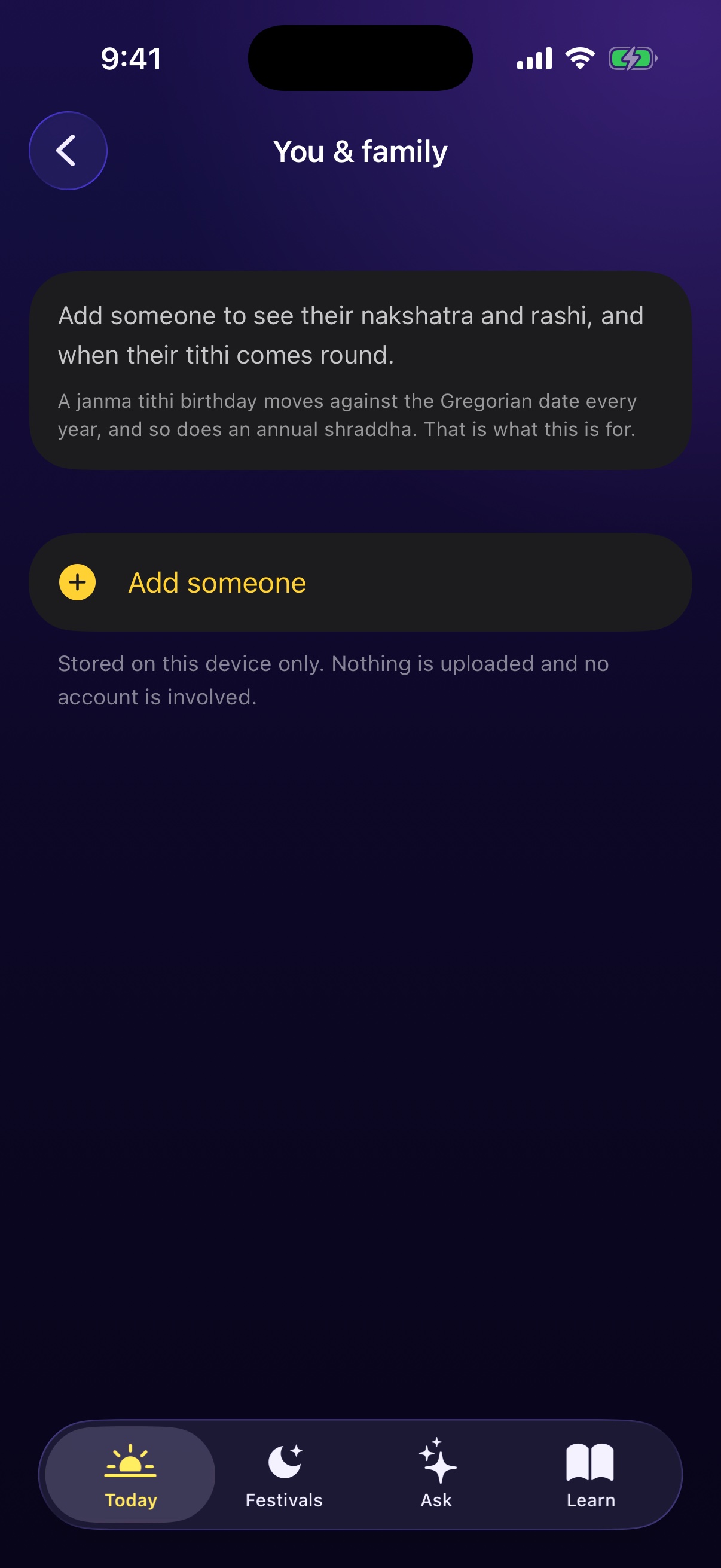
You & family

The birthday the Panchang keeps.

Enter a birth — date, time and place — and Muhurtha works out the nakshatra and its pada, the moon and sun rashi, the tithi, the month, and the syllable a name traditionally starts with.

Then it tells you when that tithi next comes round. A janma tithi birthday, or an annual shraddha, lands on a different Gregorian date almost every year, which is exactly why families lose track of them. Muhurtha puts a card on Today when one arrives.

Nakshatra & pada Naming syllable Tithi birthday Varshik shraddha
A birth reading showing nakshatra, rashi, tithi and the next tithi birthday
Ask

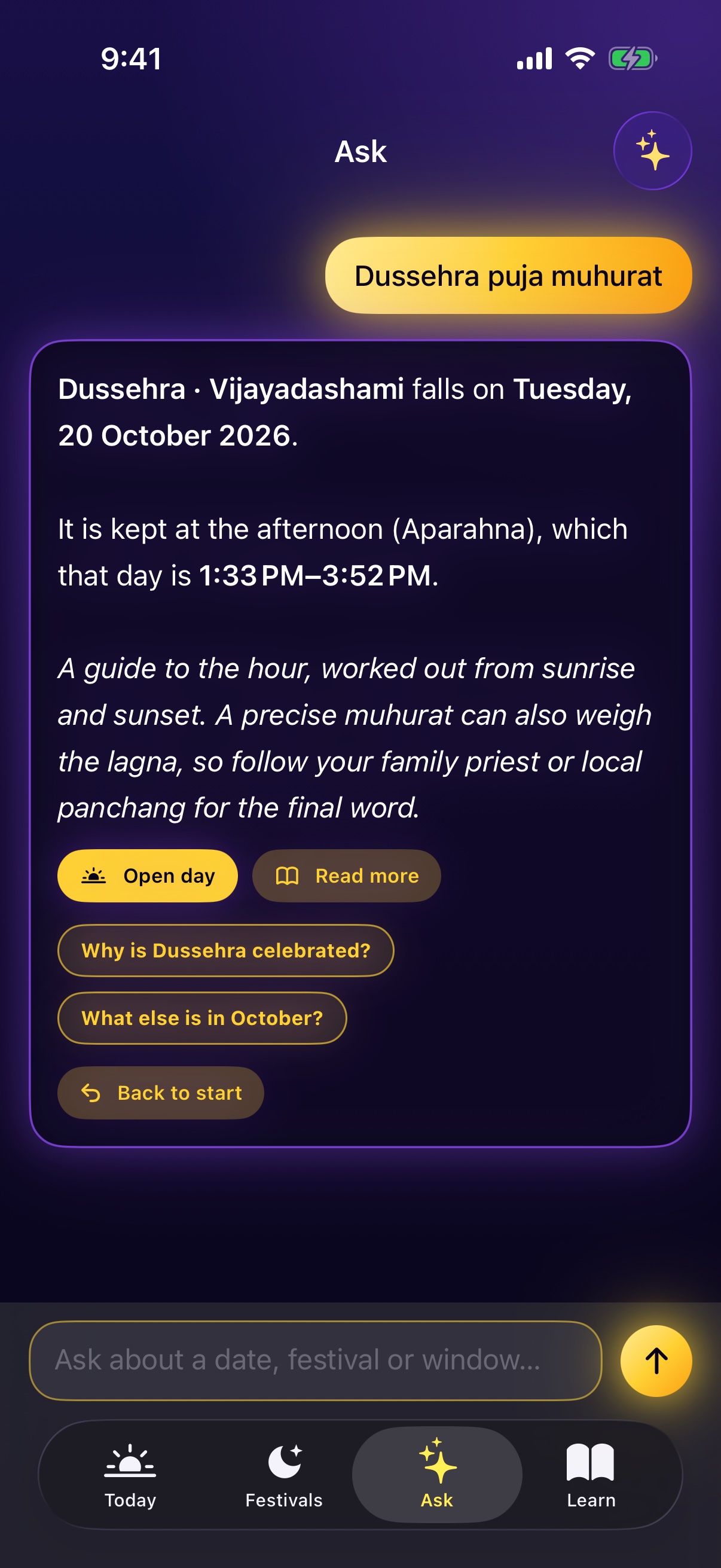
Ask it in your own words. It answers offline.

"When is Diwali 2026?" "What is Ekadashi?" "Rahu Kaal today." "Festivals in October." Muhurtha reads the question, works the answer out from its own Panchang, and offers to open that day or read the story behind it.

It also does the thing relatives ask for: give it a date, time and place of birth and it works out the nakshatra, pada, Moon sign and the letter a name would start with, the same way the app does for anyone you add to your family.

There is no server and no model call. The assistant is rules over the same engine the rest of the app uses, which is why it works on a plane and why nothing you type leaves your phone.

Asking when Diwali 2026 falls and getting the date with context

What else is in there

Four tabs — Today, Festivals, Ask, Learn — and everything below is free.

🌒 Eclipses, judged from where you are

Solar and lunar eclipses with local visibility. If it happens below your horizon the app says so plainly, and notes that tradition holds sutak does not apply where an eclipse cannot be seen.

🌙 Moon watch

On the evenings the Moon decides something — a fast broken at moonrise, or a moon one does not look at — a card sits right under the date with the moonrise time and what to do with it.

🪐 Planets and sky news

Where the planets are tonight, and the sky events coming up, from the same calculations as the rest of the app. Nothing is looked up online.

⚖️ Muhurat extras

For those who read them: the Ganda Moola span, the rising sign hour by hour, and Panchaka Rahita. Off until you turn them on in Settings.

🗓️ Monthly PDF and regional calendars

Print a month of the panchang as a PDF. For Tamil, Malayalam, Bengali and Tulu households, the regional date sits at the top of Today, such as Aippasi 1.

📖 Vidhi and katha in Learn

Each festival and fast links to its vidhi, the way it is kept, and its katha, the story behind it, in the Learn tab.

🪔 Fasts and observances

Ekadashi with its parana window, Pradosh, Sankashti with the moonrise it actually depends on, Purnima and Amavasya — each with what it is for and how it is kept. Monthly Durgashtami and Kalashtami are an opt-in in Settings, off by default.

💧 Pitru Paksha

All sixteen shraddha days with their kutup and aparahna hours, and the annual tithi for anyone you have added.

⭐ Favourable yogas

Sarvartha Siddhi, Amrit Siddhi, Ravi Yoga, Guru Pushya and Ravi Pushya — the reason to open a Panchang mid-week rather than only on festival days.

🔔 Widgets, live countdown and reminders

Today's Panchang on the Home Screen, a countdown in the Dynamic Island (on Android, an ongoing notification) while a window is running, and notifications for Rahu Kaal, fasts, festivals and Brahma Muhurat — all opt-in.

🌐 Ten languages

English, Hindi, Marathi, Gujarati, Bengali, Tamil, Telugu, Kannada, Malayalam and Odia, for the whole app: names, festivals, stories, Learn and the widgets. Pick one in Settings, independent of your phone's language.

📤 Share a day or a festival

One tap turns a whole day into a tall picture for WhatsApp and stories: the date and moon phase, the festivals and the rule behind each, sunrise to moonset, the Panchang, every safe and caution window, and the app's address on the card. A festival shares on its own card with its story.

📚 The words elders actually use

Adhika masa, Panchak, Sankranti, skipped and doubled tithis, the six seasons, the 60-year year-names, the hours rites are tied to, the lunar birthday, nakshatra padas, rain nakshatras, and Tulu Nadu's rituals and crops, each in plain words.

📅 Your own calendar

Push a year of festivals and fasts into Apple Calendar, or the calendar on your Android phone, as all-day events, so they show up beside the rest of your life.

🔥 Prayers & aartis

The aartis, chalisas and mantras people reach for on a festival morning, with meanings alongside.

⚖️ When traditions disagree

Some years a festival genuinely falls on two different days depending on where you are and whom you ask. Muhurtha flags those instead of quietly picking one.
Where the numbers come from

Drik Ganita — computed positions, not tabulated approximations.

Muhurtha carries its own ephemeris, written in Swift: a truncated VSOP87D for the Sun and ELP-2000/82 for the Moon, with nutation, ΔT and sidereal time after Meeus. Sidereal longitudes use the Lahiri (Chitrapaksha) ayanamsa, the same one the Indian civil calendar uses. Tithi, nakshatra, yoga and karana boundaries are found by root-finding on the real angles rather than by dividing a day into equal parts.

The engine is checked against Drik Panchang for New Delhi — all five limbs, both karanas, sunrise and sunset, the months and the samvats — and that comparison is a permanent test, so it cannot drift. Eclipse times and magnitudes are checked against the NASA canon. Nothing is fetched. There is no calendar to download and no server to be down; the app works the same in a basement or on a flight.

Elevation is off by default, so sunrise matches what published panchangs print. Amanta is the default month system and Purnimanta is one tap away. The whole method is written out inside the app, under Settings.

What it is, and what it isn't

Worth being straight about before you install anything.

It is

  • A Panchang for someone who was never taught one — every term explained, in the place you meet it.
  • Entirely offline. No account, no analytics, no network calls, nothing leaves the phone.
  • Free, with no upsell. There is no Pro tier and there won't be one.
  • Honest about regional difference: pick your tradition, and see when two of them disagree.
  • Written for the diaspora too — the dates shift correctly for San Francisco or Sydney, because the Moon does not care where you moved.

It isn't

  • Astrology. There is no kundli, no chart reading and no prediction — only what the almanac itself records.
  • A replacement for your family priest, least of all for a wedding muhurat.
  • Proofread in every language. Every screen, festival, story and answer is written in English, Hindi, Marathi, Gujarati, Bengali, Tamil, Telugu, Kannada, Malayalam and Odia, but the translations have not yet had a native speaker's read-through, so expect the odd awkward phrase. Corrections are welcome.
  • Authoritative on every regional observance. Where a date came from a published source rather than a computed rule, the app says which.

Take a look

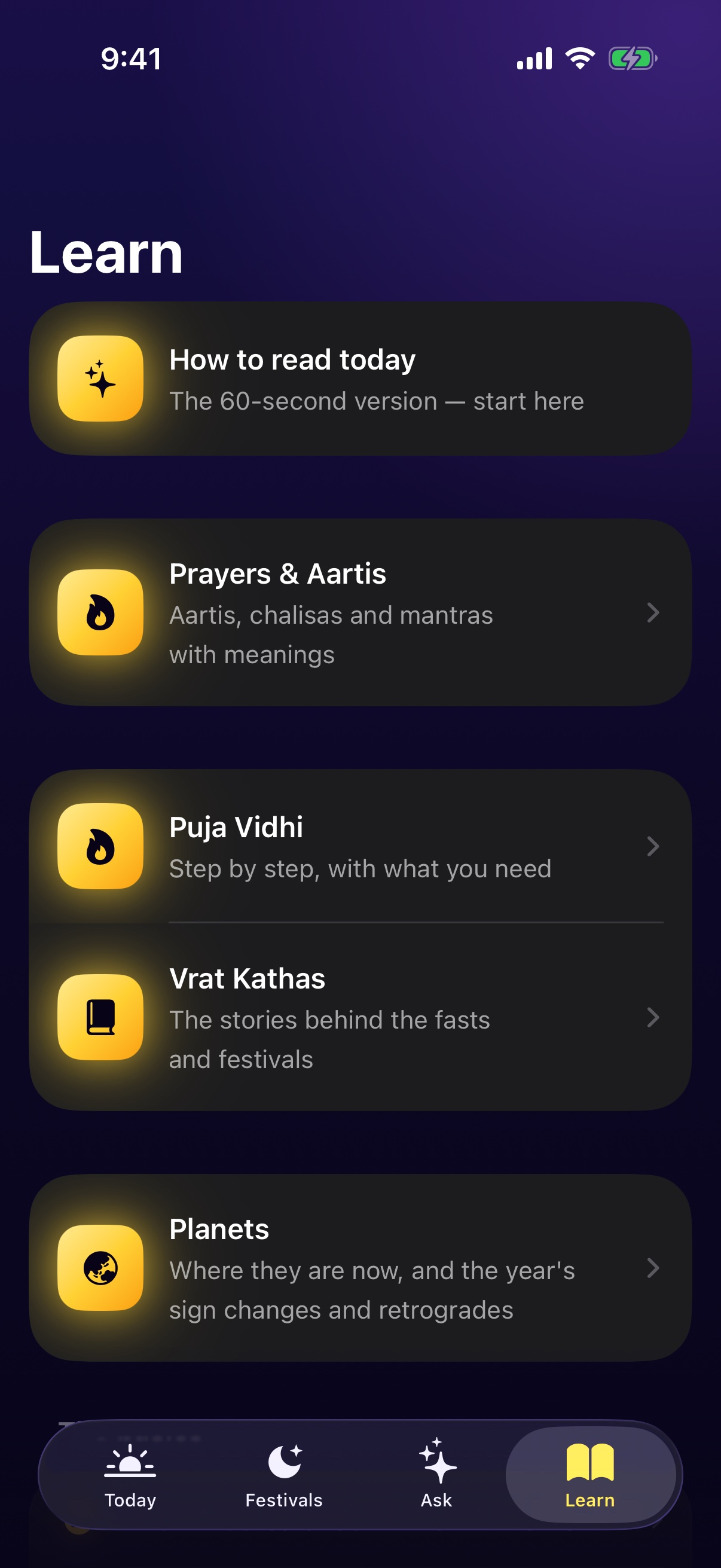
Today, the windows, a year of festivals, the muhurat finder, Ask and Learn.

Today screen
The day's windows, favourable yogas and the tithi
Rahu Kaal overriding Abhijit
A year of festivals
Wedding muhurat dates
The offline assistant
The Learn tab
A birth reading
A shared day card
The month grid

← swipe to see more →

Nobody ever explained it to me either.

Every family has someone who knows when Ekadashi falls and why you don't start something during Rahu Kaal. Ours did. But that knowledge travels badly — it lives with one generation, in one town, and the rest of us end up checking a website that prints the numbers without a word about what they mean.

Muhurtha is the version I wanted: the same numbers a good panchanga gives you, computed properly rather than copied, with a sentence of plain English next to every one of them. If you grew up with it, the dates should match what your family keeps. If you didn't, you should be able to pick it up without asking anyone.

Free, offline, no account. Like everything else here.

Read the full story →

Aniket Shetty