Muhurtha, explained
Muhurtha is a Hindu calendar and Panchang that assumes you were never taught one. It gives you the same numbers a good printed panchanga gives — computed from the actual positions of the Sun and Moon, not copied from a list — and puts a sentence of plain English next to every one of them.
This guide walks through the whole app. You do not need to read it in order; if you only want to know what Rahu Kaal is and when to avoid it, jump to Plan your day.
Get Muhurtha on the App Store — free, with no account and no ads.
Your first minute
There is no sign-up. On a fresh install a short welcome tour walks through the few choices that change what Today says — your language, your place, Choghadiya or Gowri, the festivals you keep and reminders. Every page can be skipped, and you can run it again from Settings → Show the welcome tour.
-
1Allow location, or pick a city
Every number in a Panchang depends on your sunrise, so the app needs to know where you are. Allow location once, or tap the city pill under the date and choose one by hand — search works offline against a bundled list, and reaches Apple's geocoder (on Android, the phone's own geocoder) only if you look for somewhere it doesn't carry.
-
2Read the first two cards
Anything notable about today comes first — a fast, a festival, an eclipse. Then Plan your day tells you, in one sentence, when the next good window opens and which hours to leave alone.
-
3Tap anything you don't recognise
Every term in the app opens a short explainer: what it is, what tradition says it's for, and what people do and avoid. That is the whole point of the app.
-
4Pick your traditions
Tap the gear on Today → Which festivals to show. A hundred and thirty-eight festivals is a lot if half of them aren't yours. Turn on the regions you actually keep.
There is no Pro tier, no subscription and no advertising. Everything described in this guide is in the free app.
Cheat sheet
If you remember only these, you can use the app.
The four tabs
| Tab | What lives there |
|---|---|
| Today | One day at a time. Festivals, fasts, the day's windows, the full Panchang, sun and moon. Step to any date. The gear here opens Settings. |
| Year | Every notable day of a year in one list — festivals, ekadashis, purnimas, amavasyas, shraddha days, eclipses. Search across years, and find a muhurat. |
| Ask | Questions in your own words, answered offline from the app's own Panchang. |
| Learn | Reading material: how the calendar works, every tithi, every nakshatra, every window, every fast, and the prayers. |
Reading the day
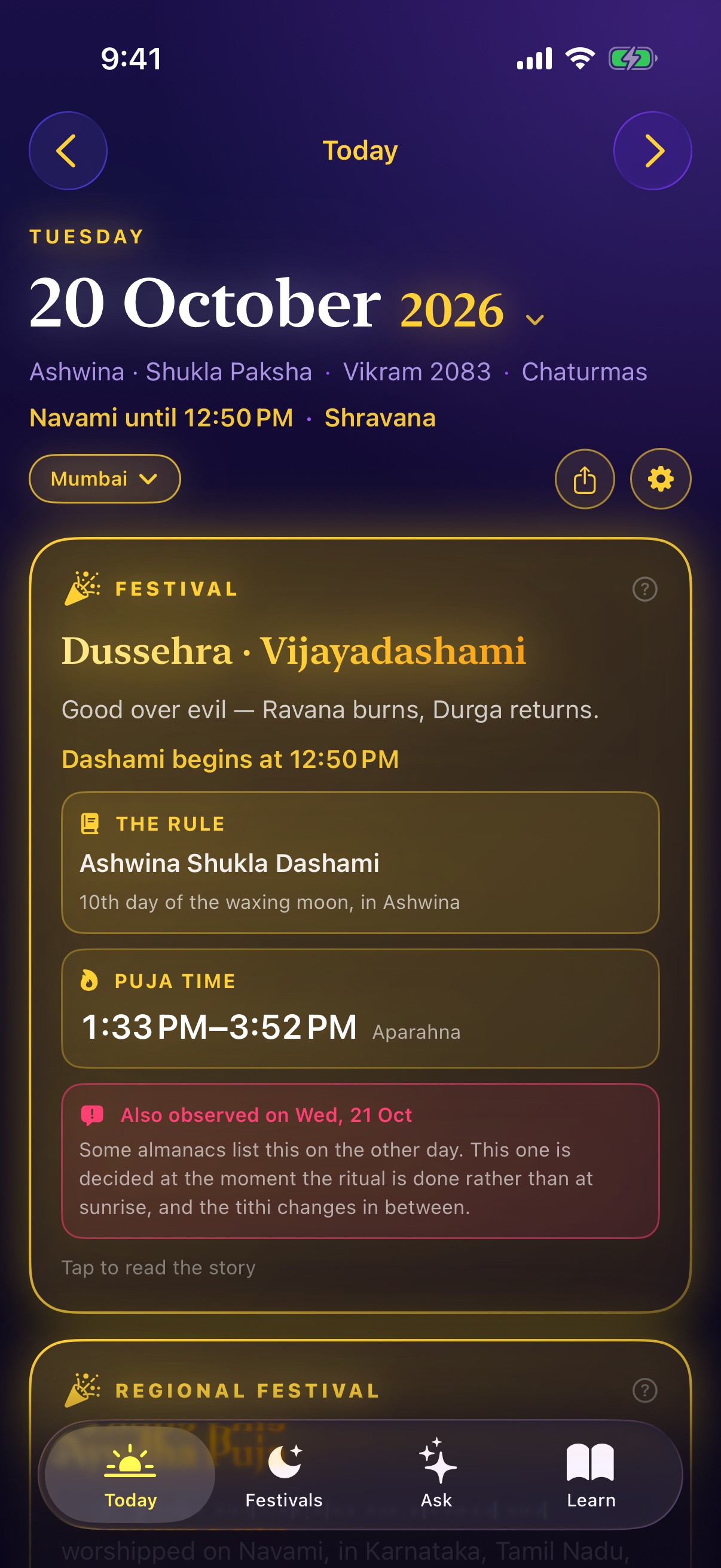
The heading gives you the weekday, the date and the year, and under it the Hindu month, the paksha and the Vikram Samvat year — so Bhadrapada · Shukla Paksha · Vikram 2083 means the bright half of Bhadrapada.
When the day crosses from one tithi into the next, the line just below the date names both: the one running now is bright and the other is dimmed, so you can see at a glance which tithi is current and which one is still to come.
Below that, the cards appear only when they apply, most important first:
Plan your day
This is the card most people open the app for. It answers one question — is now a good time to start something? — and it answers it relative to the current moment.
The first line names the window you are in, or the next one and how long until it opens. The second line is Rahu Kaal: on now, coming up in so long, or already over. Below them sit the day's windows as chips you can read at a glance.
The green windows
| Window | What it is |
|---|---|
| Abhijit | Roughly 48 minutes centred on local midday — the "victorious" muhurat, traditionally good for almost anything. |
| Amrit Kaal | Derived from the nakshatra, about 96 minutes. Considered especially favourable. |
| Choghadiya or Gowri | The day split into eight parts, each named. With Choghadiya, Amrit, Shubh, Labh and Char are the usable ones; with Gowri, the five parts called Nalla Neram. Which one is used is your choice. |
| Brahma Muhurat | The 48 minutes ending shortly before sunrise. For study, prayer and anything that wants a quiet mind. |
The red ones
| Window | What it is |
|---|---|
| Rahu Kaal | One eighth of the daylight, in a slot that depends on the weekday. The best known of them. |
| Yamaganda | Another eighth, another weekday slot. Same idea. |
| Gulika Kaal | And a third. Often treated as the mildest of the three. |
| Dur Muhurat | One or two fifteenths of the day, by weekday. Short and specific. |
| Varjyam | A nakshatra-derived stretch to avoid, about 96 minutes. |
Rahu Kaal is an eighth of the time between your sunrise and your sunset. It is not "always 4:30 to 6:00 on a Saturday". Move city, or move six months through the year, and it moves with you — which is exactly why an app that computes it beats one that tabulates it.
Choghadiya or Gowri
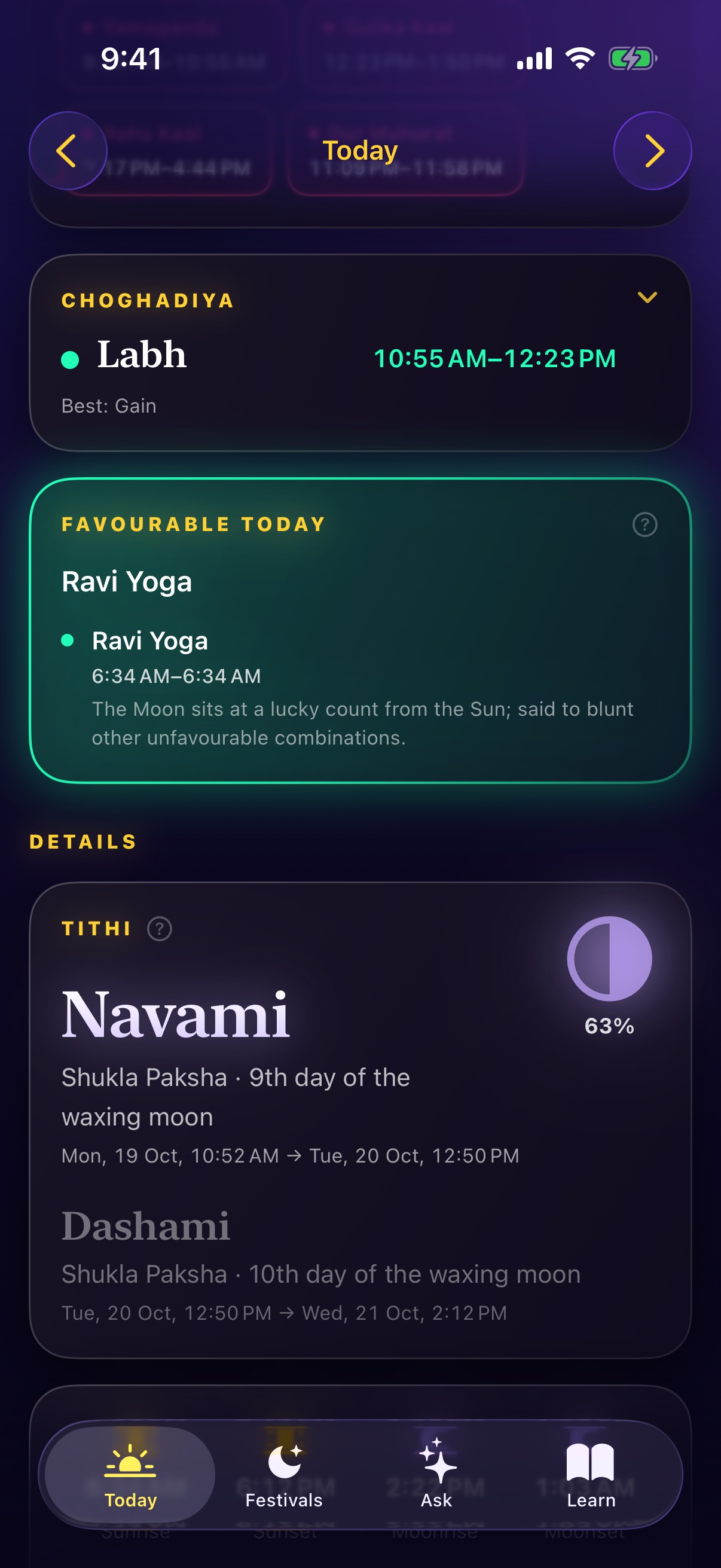
Two tables name the good and bad hours of a day. Choghadiya is read across North and West India; the Gowri Panchangam is the daily tool in Tamil Nadu and much of the South. Both cut daytime into eight parts, but they name the parts differently, so the same hour can be good in one and bad in the other.
Rather than show both and leave you to decide, Muhurtha uses the one your family follows for the good windows in Plan your day and for the "now" line on the card. The other table, and the Hora, are still there: open the card and switch between Choghadiya, Gowri and Hora.
-
1Open Settings
Tap the gear on Today.
-
2Pick under "Good and bad hours"
In What you see, choose Choghadiya or Gowri Panchangam. Today changes straight away.
If you read the app in Tamil, Telugu, Kannada or Malayalam it starts on Gowri; otherwise on Choghadiya. The welcome tour asks too, and you can change it any time.
When Rahu Kaal wins
Good and bad windows are worked out separately, so they sometimes land on top of each other. The most common case is Wednesday: Abhijit sits at midday, and Wednesday's Rahu Kaal is the fifth eighth of the day, which also sits at midday.
Muhurtha treats the red window as overriding. When that happens you will see:
So Abhijit does not count. Use another window.
The Abhijit chip stays on the card but goes grey, its hours are struck through, and it carries a line saying which window overrode it. Rahu Kaal takes the highlight instead. The headline will never offer you an eclipsed window as the day's best.
Auspicious Choghadiya and Amrit Kaal are handled the same way, except that they are dropped from the card entirely rather than shown struck through — one Labh window is much like another, so a dead one is only clutter, whereas Abhijit's silent absence at midday would look like a bug.
The five limbs
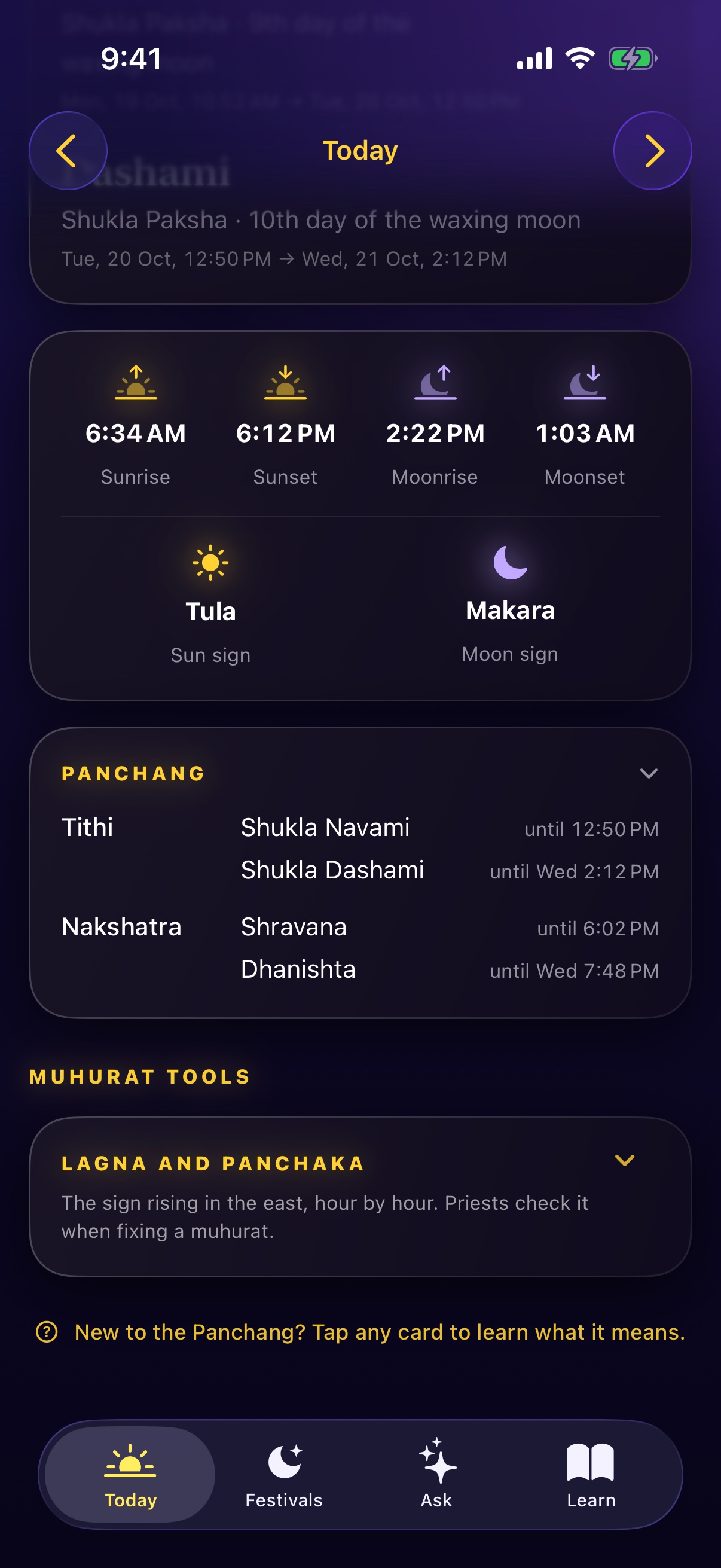
Panchang literally means five limbs. Scroll down on Today and you'll find all five with their start and end times. Every one of them is tappable.
| Limb | What it measures | Why you'd care |
|---|---|---|
| Tithi | The Moon gaining 12° on the Sun. Thirty per lunar month, fifteen per paksha. | Every festival and fast is dated by one. |
| Nakshatra | The Moon's position among 27 star-groups, each 13°20′ wide. | Your "birth star". Also decides Amrit Kaal and Varjyam. |
| Yoga | Sun and Moon longitudes added, divided into 27. | A few — Vyatipata, Vaidhriti — are traditionally avoided. |
| Karana | Half a tithi. Two each day. | Vishti (Bhadra) is the one to sit out. |
| Vaar | The weekday, sunrise to sunrise. | Decides where Rahu Kaal, Yamaganda and Gulika fall. |
This trips everyone up. If something happens at 3 AM on Thursday morning, the Panchang still calls it Wednesday. It matters for birth details, for fasts, and for which tithi "today" is.
Favourable yogas
These are combinations of weekday and nakshatra that tradition treats as lucky in their own right. They are the usual reason to check a Panchang on an ordinary Tuesday rather than only around festivals.
Sarvartha Siddhi — "accomplishing every purpose" — is the broadest. Guru Pushya is Pushya nakshatra landing on a Thursday, and is the day people buy gold. Amrit Siddhi is rarer and is double-edged in some traditions, which the app notes rather than hiding.
The card shows which are running, when they start and end, and a line on what each one is.
Changing the place or the date
A different day
The arrows either side of the title step a day at a time. Tap the year beside the date to jump to any date at all. "Today" returns you to the present.
A different place
Tap the city pill. You can use your current location, pick from cities you've saved, or search. The bundled list covers India, the diaspora and the wider Hindu world and works with no network; anything else is geocoded by Apple on your device if you're online. On Android, "Use my location" asks the phone's own geocoder to name the place, and falls back to the nearest bundled city when offline.
If you're in New Jersey and your family is in Mangaluru, some festivals genuinely fall on different days for the two of you — because the tithi has to be running at a particular moment of the local day. Switch the city and watch it happen. That's not a bug in either calendar.
A year at a time
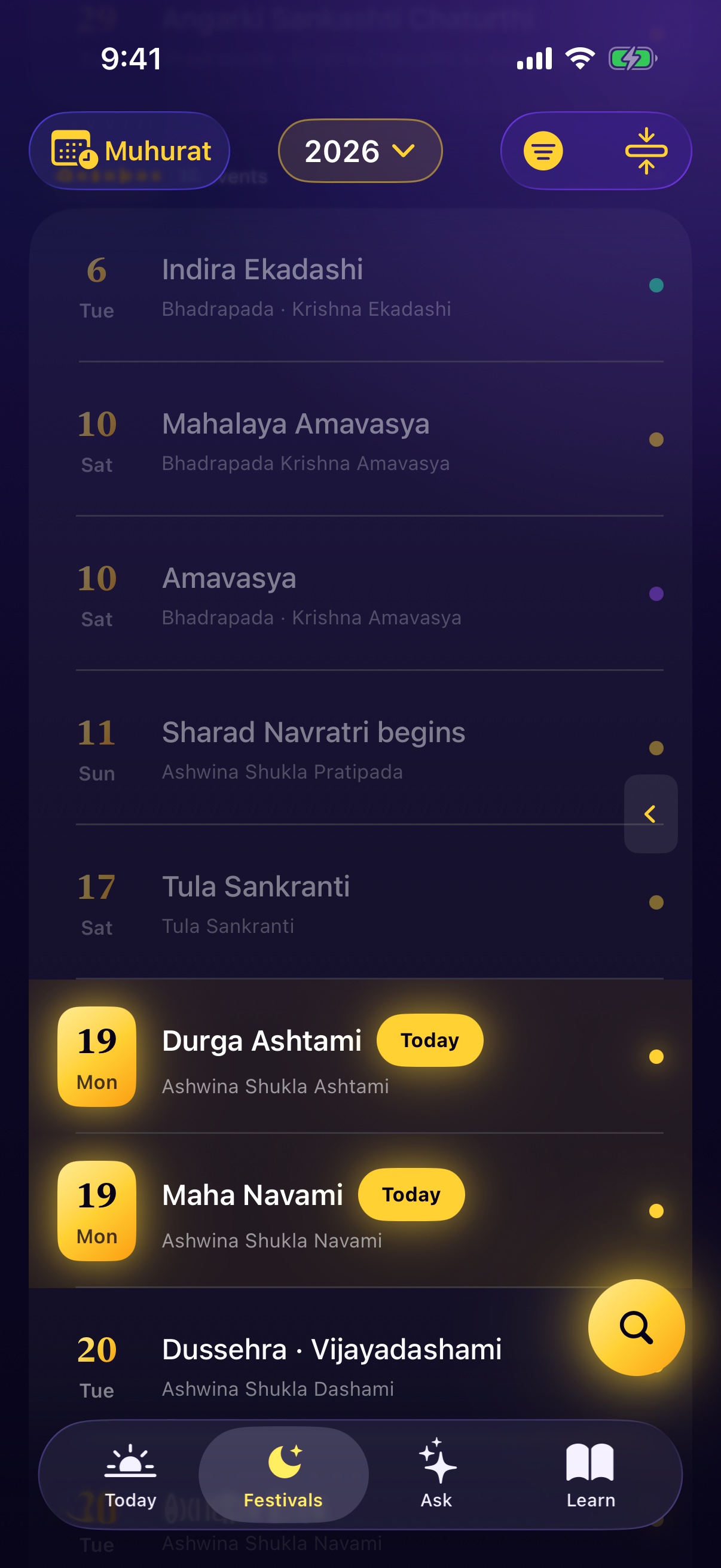
The Festivals tab lists everything notable in a year, grouped by month. Tap any entry to read about it or jump to that day on Today. The year picker sits in the middle of the toolbar; the list opens at the current month rather than at January.
The filter button on the right chooses which categories appear:
It also switches the grouping between Gregorian months and Hindu months, which is worth trying once: seeing Bhadrapada as a block, rather than split across August and September, is how the calendar actually thinks.
The floating search button finds anything by name across whatever years you've browsed.
Choosing your traditions
Muhurtha carries 138 festivals. Most households keep perhaps twenty. Settings → Which festivals to show lets you turn regions on and off:
Tap the count beside a tradition to see exactly which festivals it would add before you commit — no guessing from the name. There's also a switch for minor observances, if you want the well-known days only.
Bisu Parba, Aati Amavasya, Keddasa, Pattanaje and Mosaru Kudike are in here, dated against the Tulu solar calendar. Very little else carries them.
When two days disagree
Some years a festival genuinely falls on two different days depending on where you are and which rule your community follows. Diwali is the classic case: it wants Amavasya at twilight, and some years the tithi straddles the boundary.
Rather than silently picking one, Muhurtha flags the day and explains the alternative — which other date has a claim, and why. If your family keeps the other one, you'll at least know why the app said what it said.
Diwali 2024 was contested in Delhi and not in San Francisco. Same festival, same rule, different sunsets.
Every festival's rule
Each festival is a rule — a lunar month, a fortnight, a tithi, and the moment of the day it is judged at — not a date typed into a list. The full list of rules lives on its own page, where you can switch between Amanta and Purnimanta, filter by region, search, and pick a year from 2026 to 2040 to see the date each festival lands on.
Inside the app, the same rule sits on every festival card under The rule, and Learn → How festivals are dated lists them all.
Finding a muhurat
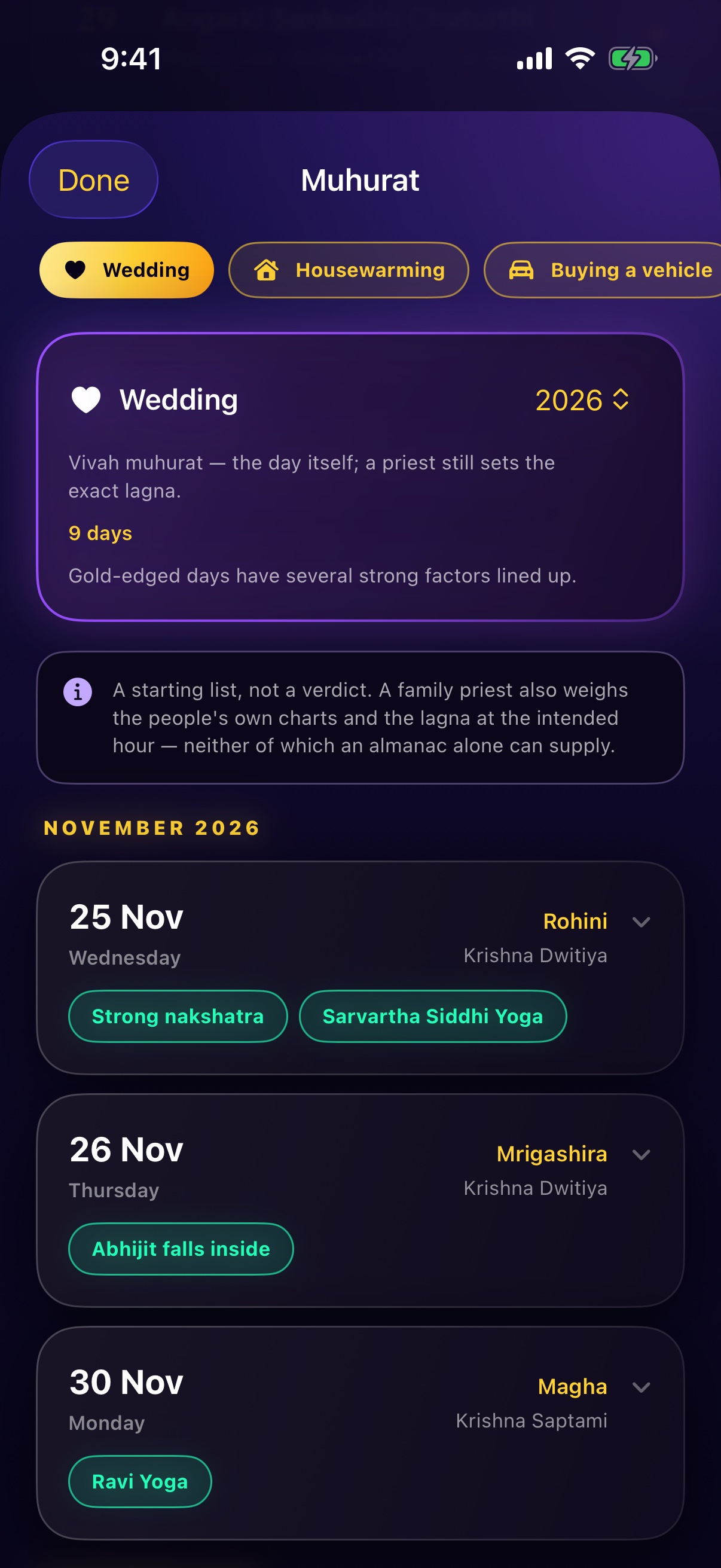
Tap Muhurat at the top left of the Festivals tab. Pick what you're planning and a year, and the app walks the whole year looking for days that clear the traditional shortlist.
Gold-edged days. A day whose card has a gold edge has several strong factors lined up at once: a favoured nakshatra (Rohini, Uttara Phalguni, Uttara Ashadha, Uttara Bhadrapada or Revati), the waxing moon, Abhijit Muhurat sitting clear of the red windows, and any favourable yoga that is running. The green chips on each card name the ones it earned, however many there are; they wrap onto further lines rather than running off the card. Gold is a way of sorting a long list, not a verdict.
What it checks
A day has to clear three lists at once — the tithi, the nakshatra and the weekday — each of them specific to the purpose. Weddings and housewarmings also respect the seasons tradition sets aside: Kharmas, when the Sun is in Sagittarius or Pisces, and Chaturmas, Vishnu's four months of sleep. Buying a car is not bound by either, so the app doesn't pretend it is.
The hours it gives you
Tap a day to open it. The app works out the stretches when a shortlisted tithi and a shortlisted nakshatra are both actually running, then cuts out Rahu Kaal, Yamaganda, Gulika and Dur Muhurat, rejoins anything a tithi change had split, and discards fragments under 45 minutes. What's left is what you're shown, with the nakshatra running through each stretch.
A family priest also weighs the couple's own charts and the lagna at the intended hour. Neither of those is something an almanac alone can supply. Use this to narrow a year down to a handful of candidate dates, then take those to whoever your family asks.
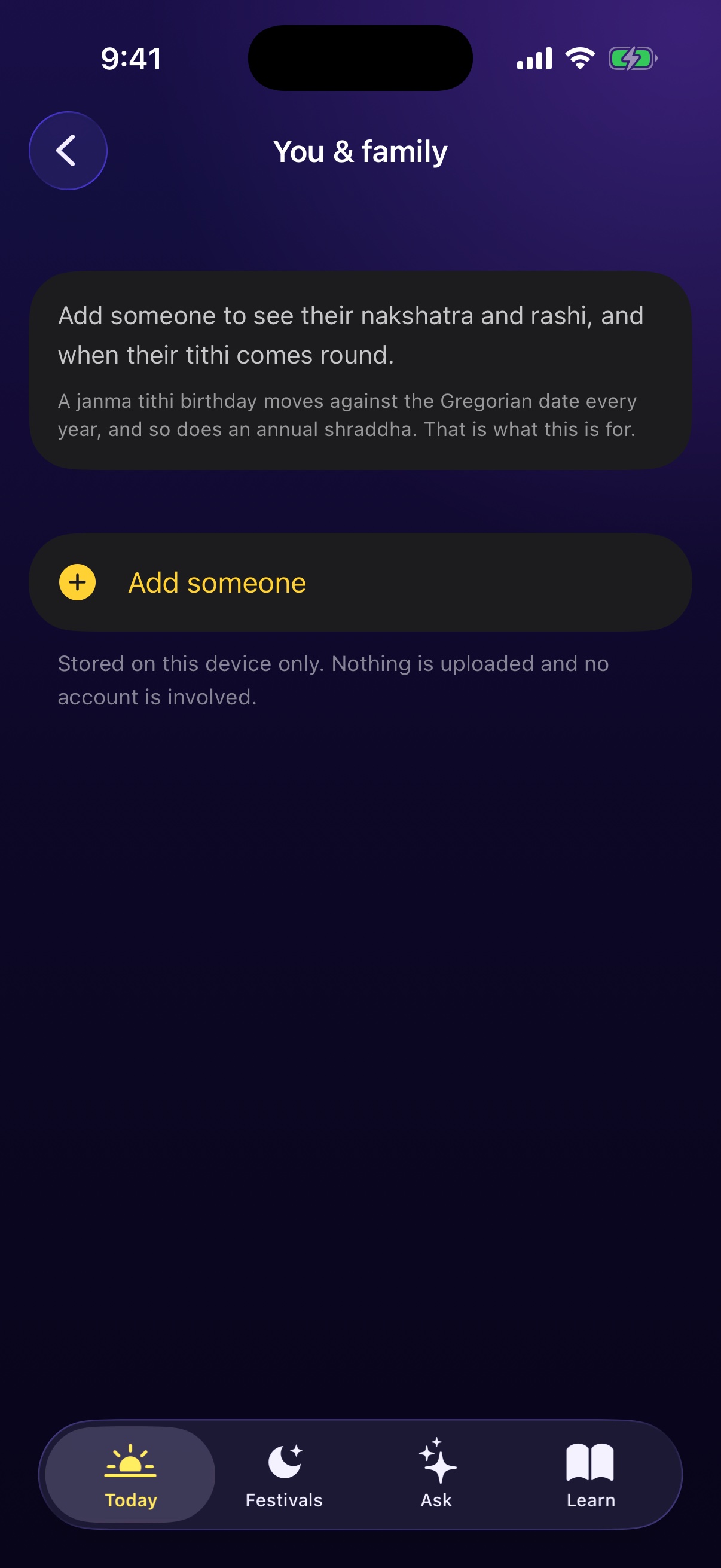
You & family
Settings → You & family. Add a person with their date, time and place of birth, and the app reads their Panchang back to you.
| It tells you | Which is |
|---|---|
| Nakshatra & pada | The birth star and which quarter of it. The pada decides the naming syllable. |
| Moon rashi | What people mean by "my rashi" — the sidereal sign the Moon was in. |
| Sun rashi | The sidereal sun sign, usually one step behind the Western one. |
| Tithi & masa | The lunar day and month — what the annual tithi anniversary is based on. |
| Vaar | The weekday, measured from sunrise. A 2 AM birth belongs to the day before. |
| Yoga & karana | The remaining two limbs at that moment. |
| Naming syllable | The sound a name traditionally starts with, from the nakshatra pada. |
Untick "I know the time" and the app assumes sunrise, which is where the Panchang day starts anyway. The tithi and rashi will usually still be right; the nakshatra can be one step out, because the Moon moves through one roughly every 24 hours. The app says so on the person's page rather than quietly presenting a guess as fact.
Names, dates and places are stored on the device and never sent anywhere. There is no server to send them to.
Tithi birthdays
Your janma tithi is the birthday the Panchang keeps: the same tithi, in the same lunar month, coming round each year. Because the lunar year is about eleven days shorter than the solar one, it lands on a different Gregorian date almost every year — which is exactly why families forget it.
Muhurtha works out the next one and puts a card on Today when it arrives. It's computed where you are now, not where you were born, because a birthday is kept where you live.
A leap month doesn't carry an anniversary, so the app looks past it to the real one.
Shraddha
Add someone as a Remembrance rather than a birthday and the app tracks their varshik shraddha — the annual tithi on which they passed — the same way.
Separately, the Festivals tab lists all sixteen days of Pitru Paksha with the tithi each one belongs to, and Today shows the kutup and aparahna windows when one falls.
Asking questions
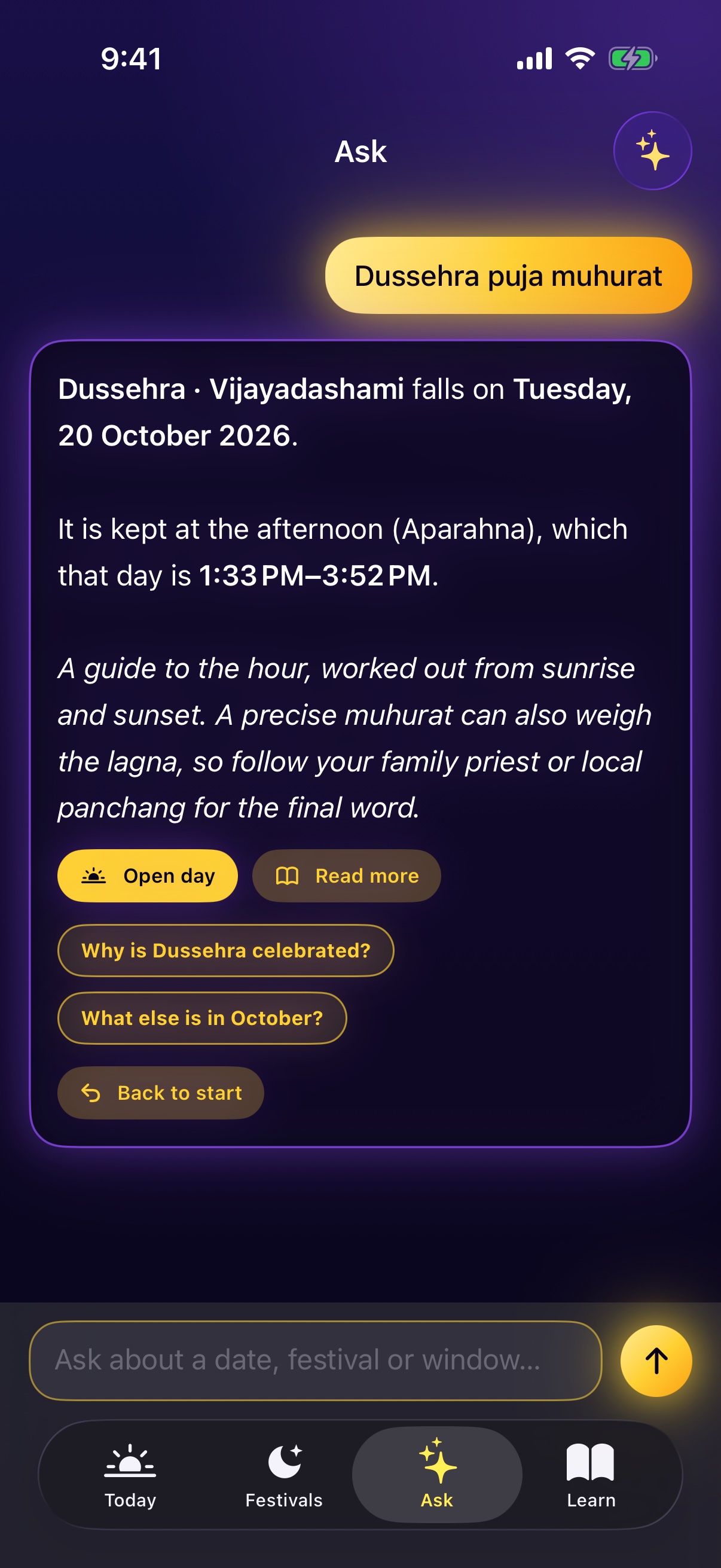
Type a question in ordinary words, or tap one of the suggestions above the box. The assistant works the answer out from the same engine the rest of the app uses, then offers to open the day or read more. The suggestions follow the calendar: they name the festivals that are still to come, a festival drops off once it has passed, and the month shown rolls forward near the end of the month, so you never see October offered in November.
Fasts, eclipses and special days
- Breaking a fast. Ask When do I break my fast? for the parana window of the next Ekadashi or other fast, with the rule that sets it (Hari Vasara, for instance). What is Parana? still explains the word.
- Eclipses. Lunar and solar are answered separately, with the local times and when Sutak begins: nine hours before a lunar eclipse and twelve before a solar one. If an eclipse cannot be seen from where you are, or is only a faint penumbral one, the answer says there is no Sutak and names the next eclipse that carries one.
- Gand Mool and Panchak. Is today Gand Mool? lists the six nakshatras (Ashwini, Ashlesha, Magha, Jyeshtha, Mula and Revati), says whether the Moon is in one now, and gives the next such day. Panchak is answered the same way.
- Colours. Colour for Thursday gives that weekday's colour; during Navratri, colour today gives the Navratri colour instead.
- Puja hours. For a festival kept at a particular hour, such as Diwali at Pradosh or Janmashtami at midnight, the answer gives the window as well as the date.
Questions that need a birth date
Choose Find my nakshatra and rashi, Find my janma tithi, Find festivals on my birthday or Find the Shraddha date and Ask shows a small form for the date, time and place. It then gives:
- the nakshatra, pada, Moon sign, Sun sign and naming syllable, using the same rules as the birthdays under You & family. If you do not know the time and the Moon changed nakshatra that day, it says so rather than guessing;
- your janma tithi, the lunar birthday, and its next two dates;
- the festival that falls on your birthday, which needs only the date;
- a parent's Shraddha tithi, from the date of passing, with its next two dates. If the time is not known the tithi at 6 AM is used, so confirm it with your priest.
After every reply a Back to start option returns to the beginning, and so does the sparkles icon in the tab bar.
A thousand written answers
Ask also carries written answers to a thousand questions people commonly put about the Hindu calendar, festivals and rites — Why is rice forbidden on Ekadashi?, What is Gandanta?, Can women offer water on the Shivling? — and uses one when your question is close to it. These answers are fixed text and carry no dates, so they never go out of date. When an answer is about a festival, a chip such as When is Diwali? sits beneath it, and one about a recurring observance offers Next Ekadashi, Next Pradosh and so on. Tap it and the date is worked out then, for the year you are in.
In your own language
You can type a question in Devanagari, Bengali, Gujarati, Kannada, Malayalam, Tamil or Telugu script as well as in English or Roman letters (Diwali kab hai), and the suggestion chips work in whichever language the app is set to. Replies that are worked out from the Panchang appear in your language. The thousand written answers are in English for now.
It's rules over the app's own Panchang, which is why it works with the phone in airplane mode and why nothing you type is sent anywhere. It also means it can only answer about dates, festivals, windows, rites and terms — ask it about the weather and it will say so. The written answers were composed for the app and have not yet been checked by a priest or scholar, so where families differ they say so; for anything that matters, such as a death rite, ask your family priest.
Sharing a day or a festival
The share button beside the place name on Today sends that day as a picture: the date, the Hindu month and fortnight, the tithi and nakshatra, the green and red windows, and any festival with the rule that fixes it. In the Festivals tab, opening a festival offers Share this festival, with the rule and the start of its story. The picture is drawn on your phone when you tap share and is sized for WhatsApp and stories. Nothing is uploaded.
The Learn tab
Reading material, and nothing else. Start with How to read today — the sixty-second version — then browse:
Every festival also has a story in its own sheet: what it commemorates, and how it is kept.
Prayers & aartis
The aartis, chalisas and mantras people actually reach for on a festival morning, with their meanings beside them. Today also surfaces the relevant one on the day it's wanted — Ganesh's aarti on Ganesh Chaturthi, without you going looking.
Reminders
All off until you allow notifications, and then each one is separate:
| Reminder | When it arrives |
|---|---|
| Rahu Kaal starting | Thirty minutes before it opens. |
| Fasts and parana | The morning a fast begins, and when its parana window opens. |
| Festivals | The evening before, while there's still time to prepare. If several fall on the day, the alert names all of them. |
| Purnima & Amavasya | The evening before each full moon and new moon. |
| Navratri colour | The evening before each of days two to nine: which colour to wear, and the form of Durga. |
| Brahma Muhurat | The quiet hour before sunrise. |
| Sunrise Panchang | Today's tithi and nakshatra, at sunrise. |
Festival, Purnima/Amavasya and Navratri alerts follow the traditions and month system you chose. They're scheduled a fortnight ahead by your own device and refreshed whenever you open the app or return to it. There are no push notifications, so there's no server sending you anything.
Widgets & countdown
Long-press the Home Screen, tap +, and search for Muhurtha. The widgets show today's tithi and nakshatra and the next window, and update through the day.
The Live Activity is opt-in, under Settings. Turn it on and a countdown appears on the Lock Screen and in the Dynamic Island while Rahu Kaal or Abhijit is running, then clears itself when the window closes. If iOS has Live Activities switched off for the app, Settings says so instead of failing silently.
On Android there is a home-screen widget (long-press the home screen, choose Widgets, and find Muhurtha), and the countdown is an ongoing notification. Turn on Live window in Settings and a countdown sits in the notification shade while Rahu Kaal or Abhijit is running, then clears itself when the window closes.
Calendar
Settings → Add to Apple Calendar writes a year of festivals and fasts into a calendar you choose, as all-day events. It asks for write-only access, so it cannot read anything already in your calendar — and iOS enforces that, not just the app.
On Android, Settings → Add to Calendar does the same. Android has no write-only calendar permission, so it asks for calendar access; the app uses it only to find a calendar to write to and to replace the events it added itself, and it does not read your other events.
Export as CSV or PDF
Settings → Export festival calendar builds a year of festivals for your city and month system, and gives you three ways to take it with you:
| Option | Good for |
|---|---|
| Save CSV to Files | A spreadsheet in Excel, Numbers or Sheets. One row per festival per region, with the tithi that decides it and a note where the date is a judgement call. |
| Copy CSV / Share CSV | Pasting straight into a sheet, or sending it by AirDrop or Mail. |
| Share PDF | Something to read or print: month by month, with the major festivals starred and each region colour-coded. |
Dates are worked out for the city shown at the top of Today, so change the place first if you want someone else's calendar.
Languages
Muhurtha speaks nine languages. Everything is translated: the screens, every tithi, nakshatra and festival name, the story behind each festival, the Learn topics, the Ask answers and the widgets.
Changing it
Open Settings → Language and pick one, or leave it on Follow device to use your phone's own language. The choice belongs to the app, so an English phone can show the Panchang in Kannada, and a household can read it in the language it is discussed in. Names change with it: the same nakshatra is spelled Rohini, रोहिणी or ரோகிணி everywhere it appears.
The translations are complete but have not had a native speaker's review, so expect the odd awkward phrase. Ask reads questions typed in any of those scripts, and its answers from the Panchang appear in the language you chose; the thousand written answers are in English for now.
Amanta or Purnimanta
North and south India disagree about when a lunar month ends. Amanta months end at the new moon and are used across the south and west. Purnimanta months end at the full moon and are used across the north.
The festivals land on the same days either way — only the month name for the dark fortnight differs. Muhurtha defaults to Amanta and shows both on a person's birth reading. Switch in the Festivals tab's options, or see which you're on in Settings.
How it's worked out
Muhurtha uses Drik Ganita — computed positions — rather than the older tabulated approximations. It carries its own ephemeris written in Swift:
| Part | Method |
|---|---|
| Sun | Truncated VSOP87D, accurate to about one arcsecond. |
| Moon | ELP-2000/82, accurate to about ten arcseconds. |
| Nutation, ΔT, sidereal time | After Meeus, Astronomical Algorithms. |
| Ayanamsa | Lahiri (Chitrapaksha) — the one the Indian civil calendar uses. |
| Limb boundaries | Root-finding on the real angles, not equal division of a day. |
| Eclipses | Meeus chapter 54, with local visibility from your horizon. |
The engine is checked against Drik Panchang for New Delhi — all five limbs, both karanas, sunrise and sunset, the months and the samvats — and that comparison is a permanent automated test, so it can't quietly drift. Eclipse times and magnitudes are checked against the NASA canon.
Elevation is off by default, because published panchangs compute sunrise at sea level and turning it on would put the app a couple of minutes out from what your family is reading. You can switch it on if you want the physically accurate time for a hill station.
There's no calendar to fetch and no server to be down. The app computes 1900 to 2100 from first principles, on your phone, in milliseconds.
Glossary
| Term | Meaning |
|---|---|
| Panchang | "Five limbs" — tithi, nakshatra, yoga, karana, vaar. |
| Tithi | Lunar day. 1/30th of a lunation. |
| Paksha | Fortnight. Shukla is waxing, Krishna is waning. |
| Nakshatra | One of 27 lunar mansions. |
| Pada | A quarter of a nakshatra. Decides the naming syllable. |
| Rashi | Zodiac sign, sidereal. Moon rashi is the everyday "my rashi". |
| Masa | Lunar month. Chaitra through Phalguna. |
| Adhika masa | The leap month, roughly every three years. |
| Kshaya tithi | A tithi that begins and ends within one day, so no sunrise falls in it. |
| Samvat | Era year. Vikram Samvat, or Shaka Samvat. |
| Sankranti | The Sun entering a new rashi. Basis of the solar calendars. |
| Vrat | A fast or observance. |
| Parana | The window in which a fast is broken. |
| Muhurat | An auspicious span of time for doing something. |
| Lagna | The rising sign at a given moment. A priest sets this; the app does not. |
| Kharmas | Sun in Sagittarius or Pisces. Weddings are avoided. |
| Chaturmas | Vishnu's four months of sleep. Weddings are avoided. |
| Shraddha | Rites for ancestors. Varshik shraddha is the annual one. |
| Sutak | The observance period around an eclipse. |
| Ayanamsa | The offset between the tropical and sidereal zodiacs. |
FAQ
Why don't the dates match the calendar on my wall?
Usually the month system or the tradition. Check whether your calendar uses Amanta or Purnimanta, and whether the festival you're looking at belongs to a region you've turned off. If it's a genuinely contested date, the app will say so on the day.
Why is Rahu Kaal a different time than I remember?
Because it's computed from your sunrise and sunset, not looked up. It moves with the city and with the season. The remembered "always 4:30 on a Saturday" is a rule of thumb for one latitude at one time of year.
Does it need internet?
No. Never, for anything in the Panchang. The only optional network call in the app is the phone's own geocoder: Apple's on iPhone, only if you search for a city that isn't in the bundled list; on Android, when you tap "Use my location" and the phone is asked to name the place.
Will it drain my battery?
No. A day's Panchang takes a few milliseconds to compute and nothing runs in the background except the notifications you asked for.
Is there a kundli or horoscope?
No, and there won't be. Muhurtha reports what the almanac records. It makes no predictions and reads no charts.
What years does it cover?
1900 to 2100. Everything in that span is computed, not tabulated.
Can I use it outside India?
Yes — that's a large part of why it exists. Pick your city and the whole calendar re-derives for your sunrise. The bundled city list covers the diaspora specifically.
Is my data backed up?
Saved places and family details live on the device only. There is no cloud sync, so reinstalling the app starts fresh.
Known limits
Worth being honest about.
- Languages. Every screen, festival, story, Learn topic and Ask reply worked out from the Panchang is written in Hindi, Marathi, Gujarati, Bengali, Tamil, Telugu, Kannada and Malayalam as well as English. The translations have not yet been read through by native speakers, so expect the odd awkward phrase, and please tell us about them. The thousand written answers in Ask are in English only.
- Written answers. The thousand written answers in Ask were composed for the app and have not been reviewed by a priest or scholar. Practices around death rites, menstruation customs, gemstones and regional observances differ between families and communities, and those answers say so; follow your own family's practice.
- Days that depend on convention. Varalakshmi Vratam, Attukal Pongala and the Sant Dnyaneshwar and Tukaram observances are dated by the usual convention, and almanacs can differ by a day. Where the app knows a date is split, it says so on the day.
- Devotional texts. The aartis and chalisas need a proofread against an authoritative printed source before they can be called final. The Hanuman Chalisa is currently partial.
- Naming syllables. The nakshatra-pada table is the commonly published one, but families use it to name children, so it deserves checking against a printed source rather than being taken on trust.
- A few regional dates. Keddasa and Pattanaje are placed from published dates rather than from a computed rule, and the Tulu month-start convention follows the Tamil one. A local panchanga should have the last word.
- Solar eclipse visibility. The app can tell you the Sun is above your horizon at greatest eclipse, but not whether you're inside the shadow path — so it says exactly that, rather than claiming a visibility it can't establish.
- No lagna. Muhurat suggestions are day-level and window-level. The rising sign at a particular hour is a priest's job.
Privacy
No accounts, no analytics, no ads, no tracking SDKs, no server. Locations, family details and preferences are stored on your device and never transmitted. Notifications are scheduled locally. Calendar access is write-only. There are no purchases.
The full policy is at aniketshetty.com/muhurtha/privacy, and questions are welcome via Support.